Ever think science has all the answers? Think again. For all our fancy tech, space telescopes, and quantum theories, there are still mysteries that leave even the smartest scientists scratching their heads. From strange cosmic signals to bizarre human phenomena, some things just refuse to fit neatly into our equations. Let’s dive into the weirdest stuff science still can’t explain.
The Fingerprint Paradox:
Common things science still can’t explain. Fingerprints. That’s right. The first entry on this list is something that we all have access to at our fingertips. And that’s because it literally is our fingertips. Or more specifically, our fingerprints. I think we all know that everybody has fingerprints. And beyond that, we all have unique fingerprints. We also know that the fingerprints your cousin leaves on every device’s glass are really annoying. But beyond the existence and uniqueness of fingerprints, what is there not to know?
And the answer is, well, the purpose of fingerprints to begin with. Interestingly, we actually know a lot more about the origin of fingerprints than the purpose of fingerprints.
Obviously, in modern times, the fingerprint is an extremely useful tool, most commonly used in forensic investigations and also while opening your iPhone 10. And while those are definitely interesting use cases for our fingertips, the human body didn’t spend hundreds of thousands of years just to develop fingerprints for biometric data purposes. And like the title of this blog suggests, the true purpose of fingerprints is still relatively unknown.
The Non-Genetic Secret of Your Unique ID:
Although there are two primary theories. But before we get into those, I want to actually explain quickly how we even get fingerprints in the first place. When you were a little fetus in your mother’s womb, your fingerprints surprisingly were one of the earliest defining features developed on your entire body, obviously after your arms and hands. And these unique designs are carved into your fingertips through the pressure of amniotic fluid in your mother’s womb. The pressure of this fluid, coupled with the growth rate of your fingers and other unique factors, is what causes the consistently unique design of your fingerprint, which is really interesting.
Your fingerprint isn’t genetic whatsoever. And identical twins do not share the same fingerprint. And that same fingerprint you develop early on in your mother’s womb, you will keep until the day you die, which is also super interesting, but not quite as interesting as the two running theories on why we even have fingerprints in the first place.
Tread on a Tire vs. The Sense of Texture:
The first theory is that we have fingerprints to improve grip. This theory states that the grooves on your finger act like tread on a tire and are intended to allow you to grip, hold, and throw things more easily. And this theory makes sense and is definitely valid. And there is even evidence to support this claim. And the other primary theory for why we have fingerprints is actually for tactile reasons. This theory states that we have fingerprints to help us sense vibrations and to feel textures more fully and effectively, enhancing our sense of touch. And once again, there is evidence to support this claim as well.
Why Both Theories Are Still Just Speculation:
And while both of these theories are valid and seem extremely logical, and both share evidence that can back up their claims, there’s not yet any concrete evidence proving a specific purpose for your fingerprint, Alzheimer’s.
Alzheimer’s: The Disease We Understand the Least:
If you’re reading this blog, it’s likely that you don’t have Alzheimer’s. But if you do have Alzheimer’s, then it’s likely you’ve read this blog before and just don’t remember it.
Regardless, Alzheimer’s is unfortunately more common than you think, and most people who read this blog have likely experienced Alzheimer’s in one way or another. The reality of Alzheimer’s is horrifying and truly upsetting. And that is coming from a bystander’s perspective. I can only imagine the experience of somebody dealing with the trauma firsthand. But for how common Alzheimer’s is and how much awareness is being brought to it these days, there are still so many things that are just completely unknown when it comes to Alzheimer’s. I think it’s important to note first and foremost that Alzheimer’s and dementia are not the same thing.
And while they are related, they’re not interchangeable. And on top of that, Alzheimer’s is not a natural part of human progression. While cognitive decline is normal as you age, the rapid and detrimental decline that happens with Alzheimer’s is nowhere near normal. And for that reason, it’s not called old-timers, it’s called Alzheimer’s.
The Biological Root:
And I’m not even making this up. When I was a kid, I swear to God, I thought it was called Alzheimer’s because old people got it. And I’m just really hoping I’m not the only one who thought that. But tossing my own personal cognitive decline to the side, what is the cause of Alzheimer’s?
And the answer is complicated. As of today, the most common theory is that a combination of age-related brain changes, genetic factors, and environmental and lifestyle influences plays a role in the development of Alzheimer’s. Although the exact biological root cause of the disease is still unknown.
The Protein Puzzles:
Basically, meaning that there are a lot of ways you could potentially get Alzheimer’s, like smoking all your life or working shift work, and having a bad circadian rhythm, or potentially being genetically predisposed. And while all of these may be contributing factors, there’s not yet one underlying causality.
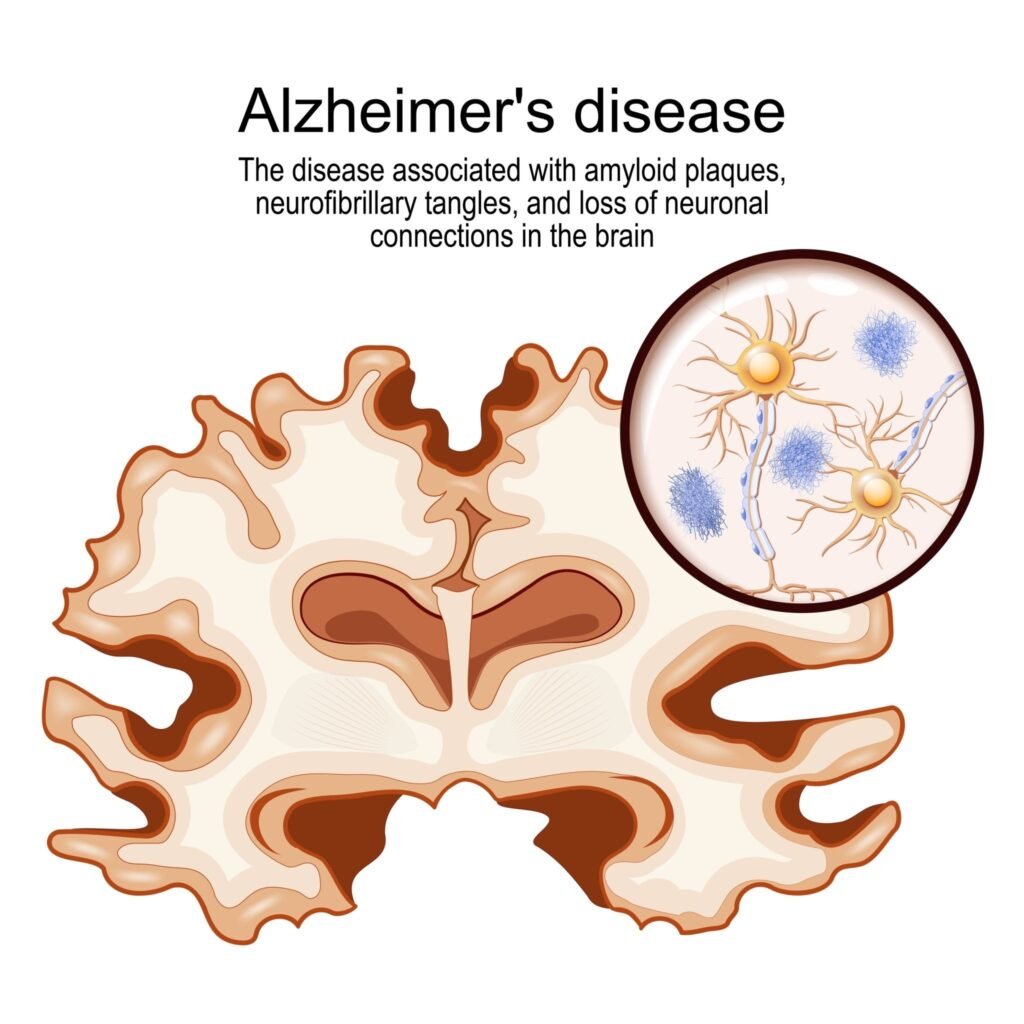
But with that being said, as of now, there are still two primary biomarkers that are believed to be tied to Alzheimer’s. The first is amyloid beta plaques. And what amyloid beta plaques are actually a buildup of amyloid beta, which is a part of the amyloid precursor protein.
What does the amyloid precursor protein do in the brain, you might ask? Science doesn’t know that either, but it’s believed, but not proven, to have something to do with brain development. Regardless, patients with Alzheimer’s will see that this amyloid beta protein is not being properly absorbed in the brain, causing it to clump together and create plaques, which causes the eventual rapid decline in cognition. And the reason for this is that these amyloid plaques are actually toxic to the brain and cause cell death within your brain.
The Drug Failure:
Which is why, typically in Alzheimer’s patients, you will see brains with massive holes in them, which honestly just adds a whole new layer of disturbing to this disease. But even the role of these amyloid plaques is debated because recently, there have been medications specifically designed to destroy these amyloid plaques in the brain. Unfortunately, these tests have not yielded positive results, which has caused scientists to question whether or not this plaque is the root cause or simply a byproduct of a deeper, more unknown root cause.
Oh yeah, and the other biomarker associated with Alzheimer’s is another protein used in the brain known as Tau. And similar to the other protein we just discussed for patients with Alzheimer’s, the tau in the brain is not used properly and is not absorbed, and becomes tangled and creates toxic clumps in the brain, causing cell death and cognitive decline.
Animal Migration’s Ghostly GPS:
So yeah, although it may seem like we know quite a bit about Alzheimer’s, there’s so much more we have to learn before we can make any sort of meaningful development in prevention and hopefully cure animal migration. Migration, by far, is one of the most underrated animal superpowers. Like, seriously, just imagine being able to be anywhere and being able to then navigate to a specific location, usually across an entire continent, just because migration is a necessary survival mechanism for countless species of animals.
And it’s actually really well understood why certain species migrate. The reason depends on the species, but the most common reasons for migration are either to feed, breed, or escape harsh climates like cold winters or hot summers.
Animals Know Where to Go, We Don’t:
And that is simple and something we truly understand. But it’s not the why of migration that’s unexplained. It’s the how. Like, just think about it. How do these animals know consistently year-over-year not only when to go, but exactly where to go? You could give a lot of people today a car and a physical road map, and they would still get lost trying to go to a specific location. But if you just tell a butterfly that they’ve got to fly 2,000 miles to get laid, they’re already gone before you could even tell them what direction to go.
And it’s so amazing, in fact, that we still to this day don’t understand how animals know where to migrate, or more specifically, how to get to their point of migration. Birds, whales, sea turtles, and even insects are all examples of animals that migrate. And for most of them, the places they go to migrate are rather specific. Although where they may be living in their offseason is kind of random. However, every year they consistently know, no matter where they are, where to go, and that phenomenon is truly amazing.
Pigeons Sensing the Earth’s Invisible Compass:

And while in 2025, humans have GPS, Google Maps, and now self-driving cars, we still get lost a lot. And this thought process has led researchers to believe that animals have something that we don’t. And recent studies have shown that this could potentially be true. One example that research has recently shown is that some species of birds, specifically pigeons, were able to sense the Earth’s magnetic field. And first of all, I’m just curious how they even found this out in the first place.
Like, I can only imagine two scientists just sitting a pigeon down in the lab, looking at him, and just asking, “Do you feel anything?” with the pigeon only to respond, “North.” And this is a skill known as Magnetoreception. And I’ll be honest, I wish I had Magnetoreception cuz that sounds cool as hell.
Regardless, with the discovery of pigeons being able to sense the Earth’s literal magnetic field, this one answer has led to many more questions, like how many other animals share this ability?
The Placebo Effect:
The placebo effect is a staple in modern medicine testing because of how prevalent this effect is. To summarize the placebo effect, it’s essentially just suggestibility. It’s your mind believing something to be true, and your body kind of following suit. And while that’s a bit of an oversimplification, the results of the placebo effect are amazing, but also mysterious.
The placebo effect is so strong and so common that anytime a new drug is tested to bring to market, they literally have to test the new drug that’s being proposed against a placebo to make sure that the drug is actually effective and not just seeming effective due to the placebo effect.
For example, let’s just say you’re trying to develop a new drug that helps people with stomach pain. Now, let’s say for a study, you find 100 people who have frequent stomach pain. You divide this group into two smaller groups: a treatment group and a placebo group.
Why Treatment Must Beat the Sugar Pill:
All 50 people in the treatment group receive the actual medication you’re testing. And all 50 people in the placebo group received well, a sugar pill, a placebo, a drug that does nothing. It’s not even a drug. Now, here’s the kicker. Everybody in this test is under the assumption that they are actually taking the active medicine. And after consistently taking the medicine for let’s say a week, you have to review the results. And this is where the placebo effect actually comes into play.
Because let’s say after a week of taking the placebo, 25 out of the 50 people in the placebo group say that they noticed less stomach pain, that is kind of the benchmark that the treatment group has to surpass. Meaning that if the treatment group also reports a 25% decrease in stomach pain, it’s actually not proven effective. In that case, it’s about as effective as a placebo. For this medication for stomach pain to be proven effective, there have to be more people in the treatment group who feel better than people in the placebo group. And this oversimplified, poorly explained explanation is what’s known as a double blind placebo study. And it’s kind of the gold standard for eliminating bias when it comes to testing brand new medications.
The Theory of Expectation:
Now, here’s the thing. With all of this being said, how does the placebo effect even work? And the answer is we actually don’t know that much about it. Researchers who have been studying the placebo effect from a psychological and neurological angle both kind of believe that this effect is linked to the brain’s release of endorphins and other chemicals in the anticipation of a positive effect.
Essentially, this means that because your body is expecting to feel better, it already kind of feels better in advance. But this isn’t proven and is really only a going theory. And despite there being literally decades of study on the placebo effect up until this point, the exact mechanisms behind the placebo effect are completely unknown, making one of the staples of modern medicine testing an effective and life-saving mystery.
The Twilight Zone:
The Twilight Zone. No, not that Twilight Zone. This Twilight Zone is home to the species that are way below the sea, where humans can’t reach. The Twilight Zone is located 200 to 1,000 m below the ocean surface. And it’s known as the Twilight Zone because it is a region underwater where sunlight barely penetrates. It’s too dark for any sort of photosynthesis, but it’s not quite pitch black yet.
Fish That Create Their Own Light in the Deep:
And it’s this unique region that is one of the least explored habitats on all of planet Earth. One notable resident of this area is the lantern fish, which is pretty cool, but also completely insane, and kind of goes to show how weird this area is. Like we all know that jellyfish are just weird creatures, but deep-sea jellyfish are on a whole another level.
Like I was just watching a documentary where some jellyfish literally asexually reproduce and basically just spawn new jellyfish, kind of like plants. And jellyfish as a whole are just kind of crazy entities. Like they’re alive, but they’re not. It’s just so wild. But that’s not the mystery here. It has nothing to do with jellyfish, per se.
The Twilight Zone, like I mentioned, is one of the least explored areas. And for good reason, too. The pressure that deep underwater is immense. And coupling that pressure with the sheer darkness and travel time, and specialized equipment required to even navigate through this area makes any sort of Twilight Zone exploration extremely expensive and difficult.
And because there’s not really a major financial incentive to explore the Twilight Zone, research is definitely a bit slow. But not only is the Twilight Zone extremely harsh to get to and be in, but it’s also extremely vast, making exploring and documenting it nearly impossible fully.
And because the Twilight Zone is so massive, it’s actually speculated that there may be more fish in the Twilight Zone alone than all other fish on the entire Earth combined. And while this is kind of a fruitless thought experiment at this point, it’s also extremely possible. But not only is it possible, it’s a scary thought because the fish that live in the Twilight Zone are completely weird-looking and probably the closest thing we have to aliens at this time. Like, these fish are literally creating their own light, which is kind of dope.
The Climate Connection:
I don’t know. I think bioluminescence is just cool to begin with. But I also like to think that fish just got so fed up with being in the dark that they literally created their own organic light. But it’s not just seeing cool fish that light up that makes the Twilight Zone interesting.
It’s also the impact that the Twilight Zone has on the Earth’s climate. Because the Twilight Zone is a massive ecosystem, and ocean and marine ecosystems specifically play a major role when it comes to carbon storage, which obviously has a direct impact on the Earth’s climate, this definitely gives merit to wanting to explore the Twilight Zone more.
But yeah, that’s kind of all there is to say about it. The Twilight Zone is one of the most common ecosystems in all of the world. Technically speaking, although it’s one of the ecosystems we know the least about, and maybe that’s for the better.
Ball Lightning: The Devil’s Glowing Sphere:
Admittedly, ball lightning isn’t all that common, but lightning is relatively common. And I think most of us have heard about ball lightning. And honestly, I just thought it was cool and wanted to discuss this interesting phenomenon. Ball lightning sightings have gone back all the way to the 1600s and continue to be reported today. It’s interesting because even today in 2025, we don’t know a ton about ball lightning.
So, I can only imagine what they thought about ball lightning in the 1600s. Ironically, we do know what they thought about ball lightning in the 1800s, as there were a few recorded accounts of experiences with ball lightning. And they basically just described ball lightning as smelling like sulfur and being the work of the devil, which I think is fitting for the time period.
The Floating Menace:
In case you’re unfamiliar, ball lightning is typically described by witnesses as a glowing, floating sphere of light. And like regular lightning, it typically only appears during thunderstorms. Some people have stated that these balls are only as small as a marble. While others have said that they’ve been multiple feet long and wide, and the colors that the ball lightning has been reported in are almost as vast as the size, with some people claiming that it was white, yellow, orange, or even blue.
But in case ball lightning wasn’t unpredictable enough, the way it behaves is also completely unpredictable. Ball lightning can last anywhere from a split second to multiple minutes. And during the duration of its stay, it typically moves slowly through the air and can even pass through windows or walls, typically causing no damage whatsoever.
And in some cases, ball lightning simply vanishes silently. And in other cases, it literally explodes with a loud bang. And already, ball lightning seems like one of the most amazing and terrifying things you could witness in person. And I can only imagine what witnessing it would be like.
Theories in the Dark:
If you didn’t know what ball lightning was. There’s actually a video of a Belarusian train station that shows a ball of lightning crossing over all of the train tracks. And it’s just amazing to see. And in the comments of this video, there are a ton of people talking about their experience with ball lightning and how the first time they saw it, they thought it was an angel or a ghost or something else that was typically supernatural, which I don’t blame them for.
If I just saw this thing in front of me in person, I would literally believe I was losing my mind or something really bad was happening. Like, I would not be in awe. I would be in terror. But that’s just me. If I don’t know about something, I typically lean towards being scared about it. But no matter how cool or interesting or terrifying ball lightning may seem, it’s more mysterious than anything else.
Obviously, scientists don’t have a concrete answer on what ball lightning is or what even causes it. But there are a few interesting theories I’d like to share with you. A couple of popular theories that try to explain why ball lightning happens include plasma, burning particles in the air, and even electromagnetic fields. And honestly, they’re all kind of vague explanations and potentially could be partially true, but like I mentioned, we just don’t know.
And one of the biggest reasons why we don’t know is because of how rare ball lightning is. It’s almost impossible to replicate in a controlled environment, meaning that we’re at the mercy of nature providing it to us to study it. And as you can imagine, ball lightning doesn’t roll into a lot of labs all that often. And well-equipped scientists typically don’t run into ball lightning all that often, either, leaving a lot of the thought around ball lightning to be up to speculation and based on reviewing videos posted online. And if you’ve made it this far in the blog, let me know. If you saw ball lightning out in the wild, would you be terrified or would you be intrigued? I think the honest answer is both.
Slime Mold Intelligence:
Now, let’s get on to the last section. Slime mold. Slime mold, or scientifically known as Physarum Polycephalum, is neither mold nor slime nor fungi. It’s actually known as a Protist. And what makes it unique is that it’s actually a single-celled organism. That’s right. This jelly-looking goo-looking thing is actually one organism. Although it is full of nuclei. That’s right. It might be a single cell, but this one cell has so many nuclei within it. And all of these nuclei actually will come in handy later.
Now, you might be asking, what’s the significance of this yellowy greenly goo? And is it even common? I’ve never seen that. And let me answer both of those questions. First of all, is it common? Yeah. If you’ve gone on a walk in a forest after a rainy day, you have definitely walked past some sort of slime mold. And to answer your first hypothetical question, why does it matter?
How Goo Solves Transportation Networks:
Well, slime molds are extremely intelligent. So intelligent, in fact, that we don’t know how they’re so smart or why they’re so smart. And that is both interesting and terrifying. How smart is slime mold, you may ask? Well, slime molds have been shown time and time out to solve mazes consistently. And how they do this is by basically filling up the entire maze with their gooey body. And once they find the exit of the maze, or in the case of the research test, finding the food, they will then retract everything else that isn’t directly connecting the start of the slime mold to the food, allowing them to essentially reverse engineer the maze.
And these mazes aren’t simple either. Some studies have actually been able to have slime molds recreate major transportation networks, like the Tokyo subway system, for example. But not only can slime navigate to find food, they’ve also been shown to have some sort of memory by anticipating recurring events.
No Brain, Still Remembering:
And how this is shown is by having them readjust their behavior based on previous events that have happened in previous studies, proving that these single-celled organisms have some sort of memory, even though they have not one neuron. That’s right. Slime molds have no brain, no nervous system, no complex organs, but they still seemingly can solve problems, make decisions, and even remember past events.
And I’ll be the first to say it. I’m impressed with this little ball of goo. And this little ball of goo might even be smarter than you. But if you think the ball of goo is not smaller than you, then for whom the ball of goo is not smaller than you, too. Okay, it is currently 1:53 a.m., and I thought that was funny. You know, I didn’t even think that was funny. I just said it.
Inspiring Engineers:
Regardless, the ways in which slime molds achieve any sort of intelligence to scientists is completely unclear. Although, like some of the other entries on this list, the scientists have their theories. And what’s currently believed is that the network-like structure of neurons within the slime mold allows the slime mold to process information through chemical signals. Essentially, allowing it to have a brain without having a brain. And this method of thinking, or I guess thoughtlessness on the slime molds’ part, has actually inspired scientists in specific fields like robotics and computing to try to use slime molds to find clues on how to build more efficient self-organizing systems.
Seeing as the slime mold’s pretty good at doing that. And while there’s not much more known about the slime mold’s intelligence at this time, the fact that this single-celled organism can seemingly think without a brain has definitely inspired engineers and scientists alike. But for now, the mind of this little ball of goo is an enigma.
Conclusion:
For all the progress science has made, the universe still holds more questions than answers. From fingerprints with no known purpose to single-celled blobs that outsmart engineers, we’re constantly reminded that knowledge has limits. And maybe that’s the best part. These mysteries keep us curious, humble, and hungry to learn more. Because the day science explains everything might also be the day it stops being fun to explore. Until then, the unknown is what keeps discovery alive.
FAQs:
1. What’s the most surprising mystery science still can’t explain?
Many would say the placebo effect, because it shows the mind’s power to heal the body, without any real medicine.
2. Why don’t scientists know the purpose of fingerprints yet?
We understand how they form, but not why evolution kept them, so their true function remains uncertain.
3. Is there any progress in understanding Alzheimer’s?
Researchers have found patterns with certain proteins, but the root cause of the disease is still unknown.
4. How do animals know where to migrate every year?
Some may sense Earth’s magnetic field, but the exact navigation mechanism is still a mystery.
5. What’s so strange about ball lightning?
It behaves unpredictably, passing through solid objects and appearing randomly, making it nearly impossible to study.
6. How can slime mold be intelligent without a brain?
It uses chemical signals across its network-like structure to solve problems, a process scientists still can’t fully explain.